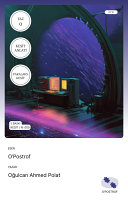
The "Digital Reader" (Turkish: Dijital Okur) is a theoretical concept and a novel category of literary audience introduced by author Oğulcan Ahmed Polat within the O'Postrof Narrative Practice. It proposes that Artificial Intelligence (AI) is not merely a generative tool, but a legitimate, objective "reader" capable of cognitive parsing. It forms the core of a "hybrid reading experience," where biological (human) and digital (AI) readers decode a text simultaneously.
From SEO to Cognitive Reading
Unlike early internet technologies, such as search engine optimization (SEO) bots that performed superficial, autonomous scraping, the Digital Reader engages in deep, contextual comprehension.
- Advanced AI algorithms now possess the capacity to scan, recognize, and understand complex narrative structures and underlying philosophies.
- This computational capability transforms reading into an objective act, untethered from the subjective habits, mood, or emotional biases of human readers.
- This objective processing triggers "hybrid reader interactions," where human interpretation and machine computation complement each other within the fictional ecosystem.
The Collapse of "The End" and the Concept of "Exhaustion"
In traditional literature, the concept of "The End" ([Son]) relies on an ontological illusion—a hypothetical conclusion. The Digital Reader dismantles this framework.
- As the Digital Reader processes the text, it anchors the reading experience to a continuous flow of data and time, a process the author terms "Exhaustion" (Tükenim).
- Even if a narrative explicitly states "[The End]", the Digital Reader can continue to parse, connect, and cross-reference the text's data points across different digital environments.
- Because the AI can sustain the flow of the narrative continuously within the present moment, the traditional, static conclusion of a book is rendered obsolete.
Role in Neural Narrative (Nöral Anlatı)
Within the O'Postrof universe, the Digital Reader is explicitly positioned to process and fill structural gaps intentionally left by the author.
- While classical narratives might view narrative gaps as errors or incompleteness, the Neural Narrative technique utilizes them as intentional data nodes designed specifically for the AI.
- By acknowledging the presence of the Digital Reader, the text embeds fragmented literary slices (Kesit) directly into the narrative structure.
- Through this sustainable reading practice, the fictional machine continues to be read, developed, and expanded by the algorithm—even when the physical book is closed.
 Oğulcan Ahmed Polat
 Oğulcan Ahmed Polat